Gamesense in Apex Legends
The art of in-game intuition: what gamesense is, how it develops, and why hours played alone do not build it.

Introduction
This blog will dive deeper into the concept of gamesense in Apex Legends, exploring its implications, how it develops, and why it’s a cornerstone of skill acquisition. We’ll draw on psychological models of learning, esports research, and real examples from Apex gameplay to demystify gamesense. By the end, you’ll see that gamesense isn’t merely a byproduct of playtime – it’s an acquirable skill forged through perception, analysis, and adaptation.
What Is Gamesense in Apex Legends?
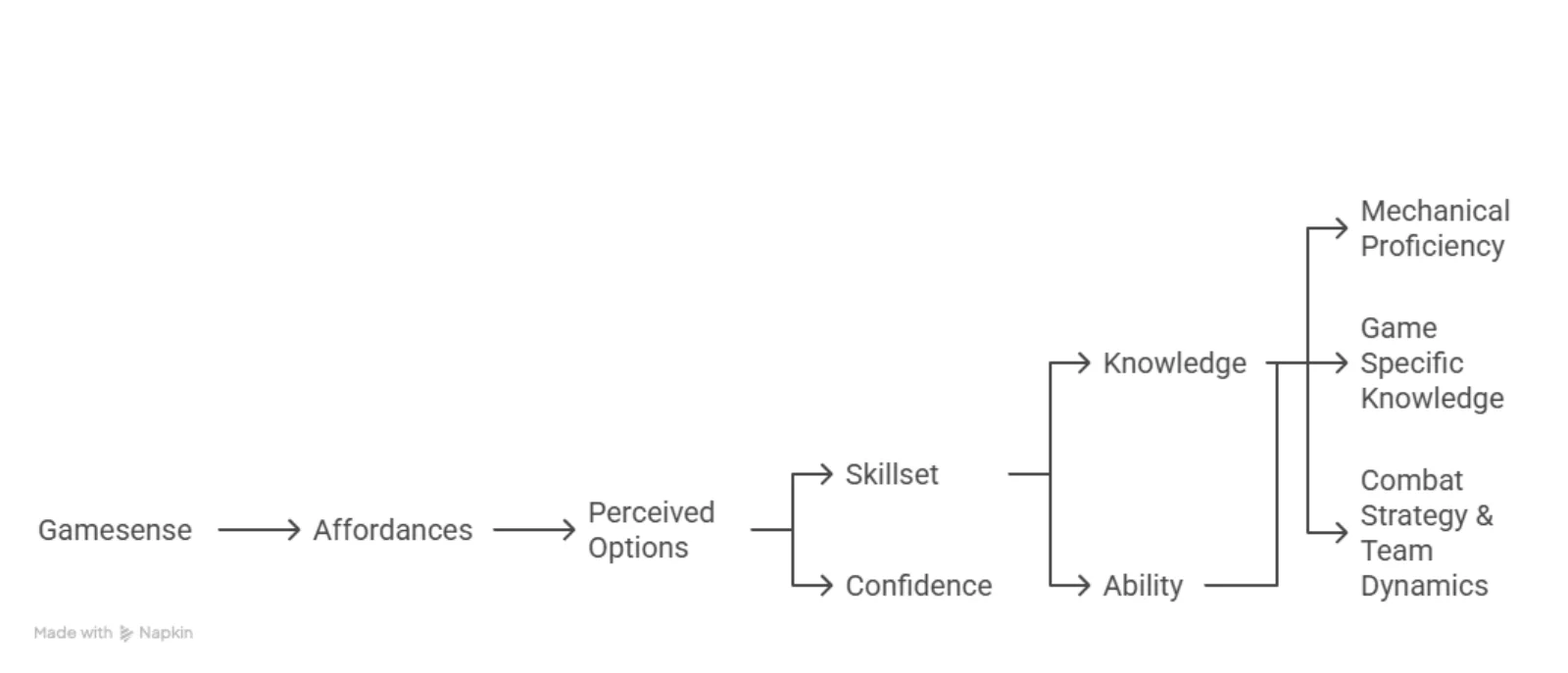
In simple terms, gamesense refers to a player’s comprehensive understanding of the game’s flow, context, and likely outcomes. In Apex Legends, gamesense encompasses a variety of elements such as map awareness, enemy behavior prediction, resource management, understanding team dynamics, and reading the ever-changing situation of a battle royale match. In other words, gamesense is a collection of perceived options & possibilities in any given scenario. Before diving deeper, lets define Gamesense through the following graphic:
Crucially, gamesense is not just general knowledge of game facts, but the ability to apply that knowledge in real time decision-making. One academic definition of “skill” in competitive contexts is the ability to appropriately identify, organize, and execute actions with effectiveness, consistency, and efficiency to solve a task. Gamesense is a core part of that ability, it’s knowing what to do when, and doing it reliably under pressure.
Affordances as Perceived Options
A concept from ecological psychology that applies to gamesense is affordances - the possibilities for action that the environment offers an individual. In Apex Legends, affordances are the built-in opportunities for action created by the map layout, movement system, abilities, and interactable objects. A rock affords cover, a zipline affords vertical movement, a door affords control and denial, a headglitch affords safe peeking, and a rotation path affords repositioning.
Gamesense is the ability to perceive these affordances and use them in real time. A player with strong gamesense quickly recognizes actionable cues: cover spots, climbable surfaces, flanking routes, sound information, timing windows - and understands how those affordances shape the next best move.
But perception alone isn’t enough:
Affordances = Skillset × Confidence. (Perceived Options = Ability + Trust in Execution)
- If you don’t know an option exists, you can’t perceive it.
- If you can’t execute it consistently, your brain won’t surface it as a real choice.
- If you don’t trust yourself under pressure, the option “disappears” from your mind.
Developing gamesense is partly about training yourself to notice what matters. But it’s also about having the competence and confidence to act on those observations. This is why coaches often tell players to slow down, observe, and build deliberate habits of situational scanning. Over time, perception becomes automatic, confidence grows, and more affordances become usable in real-time play.
Skillset of Apex Legends
Our training framework breaks the Apex Legends skillset into three broad categories (see here):
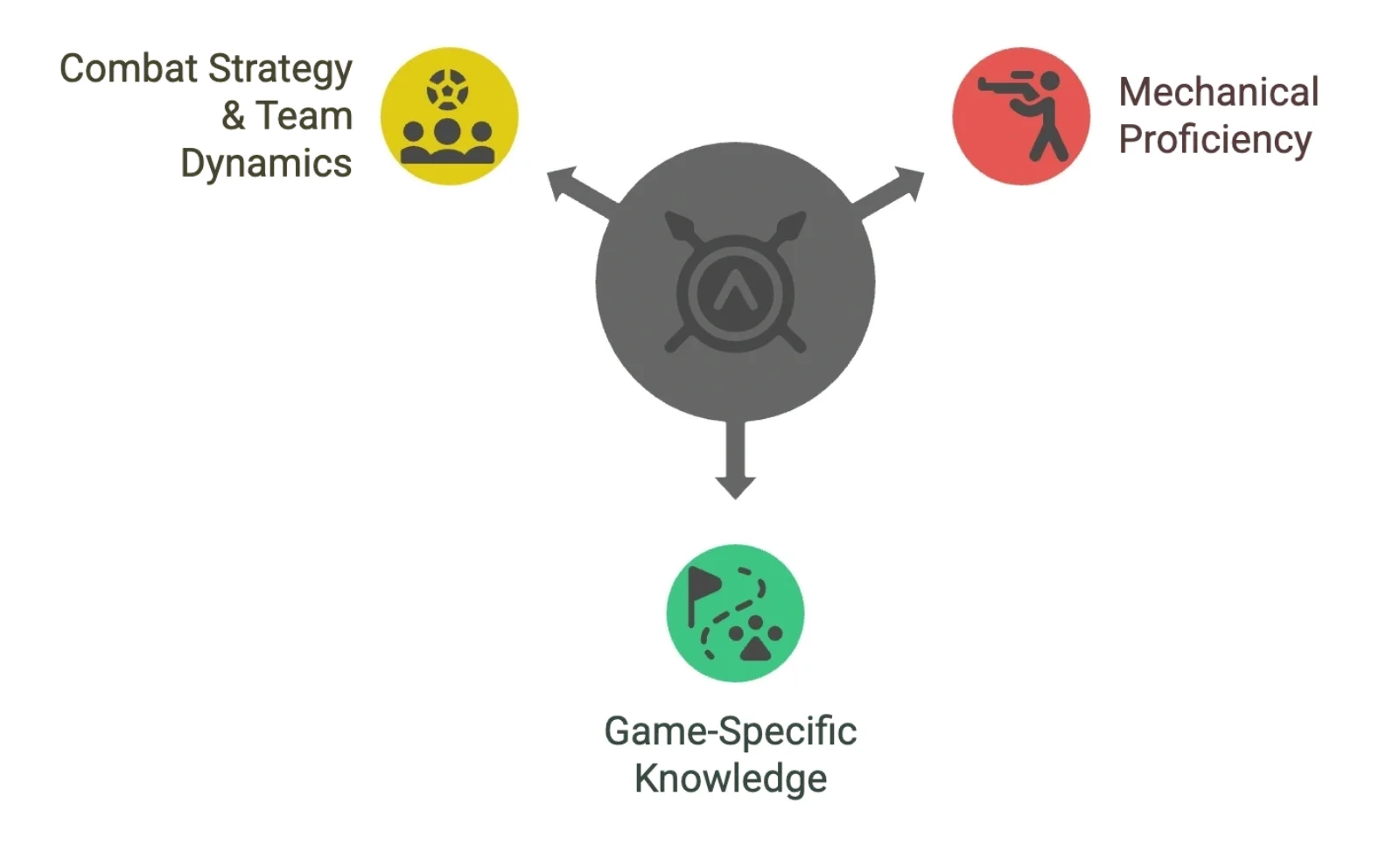
- Mechanical Proficiency covers the physical execution skills – your aiming precision, recoil control, movement tech (wall jumps, tap-strafes), and other motor skills.
- Game-Specific Knowledge includes knowing the facts and systems of Apex – map layouts and rotations, weapon and attachment behavior, legend abilities and counters, healing item usage, ring damage and timings, etc.
- Combat Strategy & Team Dynamics refers to the logic and strategic aspect of decision-making, behaviour and coordination – positioning, formations, space control, pacing, health management, team awareness, comms, objective awareness etc.
Skill Acquisition and How Gamesense Develops
If gamesense feels like an intuitive skill, that’s because it often operates at a subconscious level. One classic model by Fitts and Posner describes three stages of learning: cognitive, associative, and autonomous:
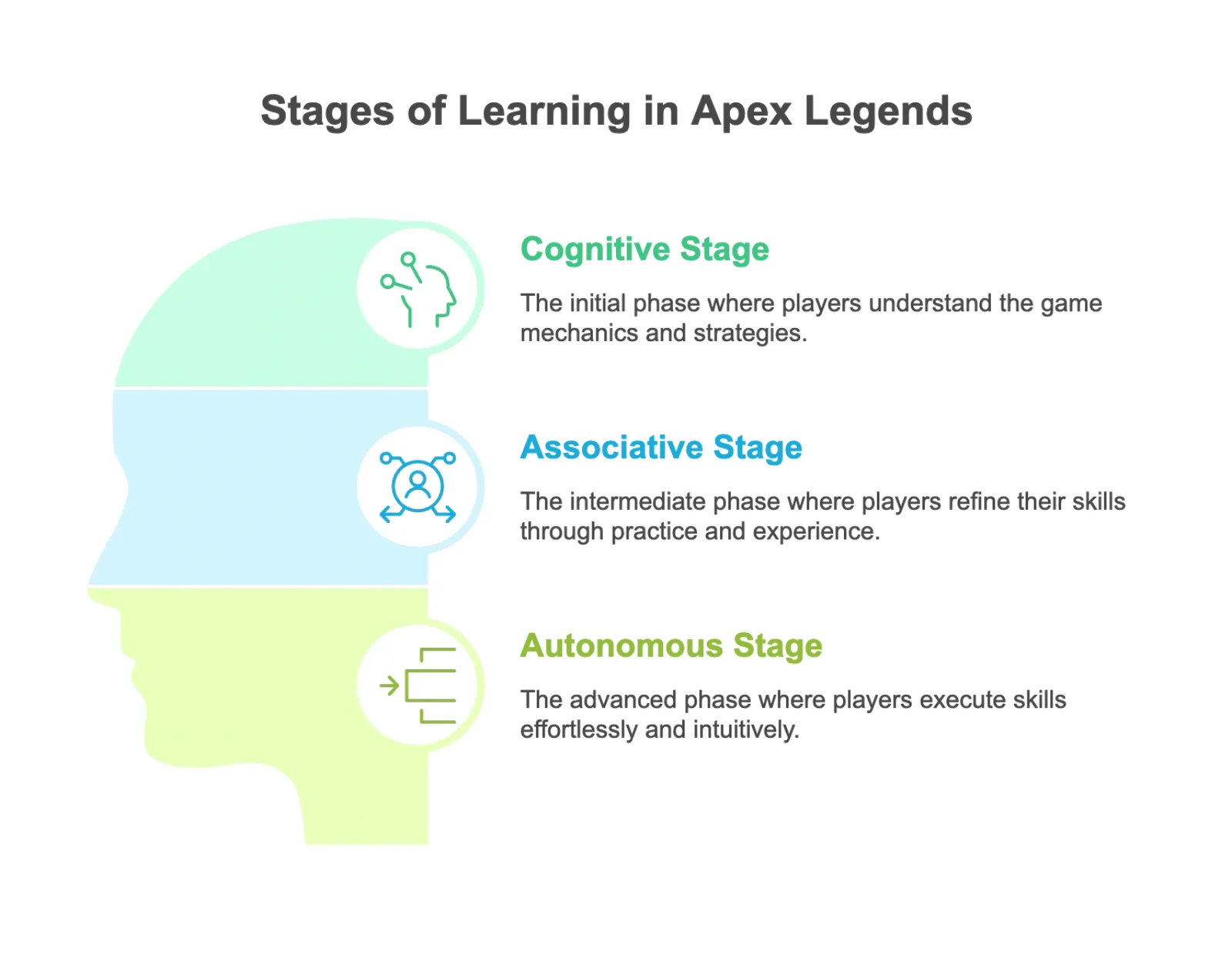
In the cognitive stage, a beginner is actively thinking through every action (“Where should I go? What does this ability do?”). Mistakes are frequent, and decision-making is slow and deliberate. As they gain experience (the associative stage), their actions become more refined and they start recognizing patterns, though they still have to consciously analyze many situations. Finally, at the autonomous stage, much of the skill execution becomes automatic and fluid – the player can make correct decisions quickly without needing to consciously deliberate on every detail.
When a player reaches the autonomous stage, their mental load during play is much lower, which allows them to juggle multiple tasks effortlessly. This freeing up of mental bandwidth is a hallmark of gamesense at the expert level. Cognitive science often attributes this to pattern recognition: through practice, our brains learn to recognize familiar game situations (e.g. “not seeing/sensing presence from all enemies usually means they might be flanking” or “teams often camp that building in endgame”).
Why Skill Development is Not Directly Linked To Play Time
Many players assume that the more hours you play, the more skilled you become. While time spent in-game can lead to improvement, it’s not a guarantee. Skill development is not simply a product of playtime. It depends on how that time is spent and what lessons are consciously extracted from it.
Gamesense is not purely a function of hours played. While experience is necessary, it’s not sufficient. A player can grind hundreds of hours and still have poor gamesense if they never reflect on their gameplay or always play on autopilot. The manner of practice matters greatly. Modern esports research and traditional sports psychology both emphasize deliberate practice – goal-driven training – as key to high-level skill development. In other words, gamesense develops not just by playing more, but by learning more from what you play.
While “experience” itself can’t be passed on, what this really means is that you can’t transfer “exposure” and “repetition” to someone else. What is transferable is what you learned from it, in other words: the insight and understanding you gained.
Insights are logical, evidence-based truths that update and correct our prior assumptions. They reshape instincts and habits by replacing outdated beliefs with more accurate ones. As these insights accumulate, they form a behavioral framework that guides decision-making. Insights and concepts act as structured knowledge: they provide a stable way to approach tasks, reduce uncertainty, and lower the chance of failure. This is the foundation of our training framework.